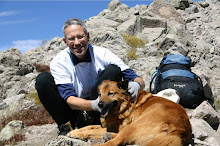
We have 4 big dogs in the family, all of whom live at our Colorado Springs home. The 10 year old, Kodi, was diagnosed last week with an osteosarcoma in her shoulder -basically a bone cancer. And the hard news is that it is terminal, apart from a miracle. The difficult decision we had to make was whether to have the leg amputated, or to have her "put down" - euthanized - soon, before that leg bone was to shatter. Ultimately, we opted for amputation. For my part in that decision, there were 3 truths that guided me. Truths that actually have a lot to do with living a missional lifestyle.
I would often talk with our veterinarian in Kansas City about end-of-life issues for our dogs, and his philosophy was simple but mature: you are responsible to do for your dogs, who are voiceless and powerless over the diseases/illnesses they have, what offers them the best quality of life, within the limits of your resources. John taught me that when we "signed on" as pet caregivers, we took on a responsibility to do for them what they could not do for themselves, within our finite boundaries. And our goal was to help the dogs have their best quality of life. As I looked at Kodi last week, happy and wagging her tail and full of energy and vitality, it was clear that she is not "done." She has a strong quality of life still possible for some undetermined length of time. That's what I signed up for, to help her have that. It was clear that the amputation was the way to go.
A second truth that helped me in the decision is the call to love, which inevitably means sacrifice. This sacrifice might mean sleepless nights, watching over meds, getting them out for exercize when one might not feel like it, sitting watch in a waiting room, financial commitment, standing by them when they are suffering, and, of course, saying goodbye when the time comes. Amputation definitely fell into this realm.
And another friend taught me the third truth. It has to do with acceptance. He said, "Acceptance is the answer to all my problems today.. . Unless I accept life completely on life's terms, I cannot be happy." Reinhold Niebuhr said something similar: "Taking, as our Lord Jesus did, this sinful world as it is, not as I would have it." In other words, if I will only accept things the way they are as the starting point, I mean, truly accept that THIS IS THE WAY THINGS REALLY ARE, I can start to celebrate what is possible in light of that starting point, instead of getting sucked down into all that I wish was different. I decided that amputation gave us as a family the chance to celebrate everything that is wonderful about this little dog, to savor every day we have left for and with her, to remember what we have adored about her and will always treasure, and to gather around her and make her last months the best they can be. That's what acceptance makes possible.
This is the way of missional living. "Signing on" with Jesus Christ leads us to decisions in which we do what we can for the voiceless and powerless of our world, within the limits of our power and resources. It means that we will make decisions which will at times cost us, even dearly, and especially in terms of having our hearts broken. And ultimately the missional lifestyle insists on our deciding to accept this world as it is, as our starting point, not some illusory fantasy of the way we wished it were right now. This, and only this, gives us the freedom to celebrate what IS possible and to embrace happiness in the midst of the shadow of sin and suffering.
You know, Kodi may not be much. She in fact is called a "tripod" now, meaning she has only 3 legs. She's lying at my feet snoring at the moment, settling back into her home in the first hours since leaving the hospital. But oh, she's not done teaching me about how to live - even how to live missionally in a ravaged, hard world full of injustice and the blight of evil. What a good dog she is.
Saturday, May 14, 2011

Tuesday, May 3, 2011
When You Know You're Getting Better
The truth is that all my adult life I have feared, hated being stopped by a policeman. The moment I see the lights, my heart leaps up into my throat, racing at an ungodly speed. My eyes whip around the dashboard, the seats, the seatbelts, anything out of place, what speed was I going, how did he get there without me seeing him, oh I HATE THIS!! The surge rising up from within is fiery shame, for having broken a rule. The humiliation of being caught by Authority burns hot in my heart. It trumpets that truth I have been trying to evade all my life - that I am a loser, a failure.
So, three weeks ago I was driving all day from Colorado Springs to Kansas City, and when I got to the outskirts of KC, barely 20 miles from my son and daughter in law's home, I saw the lights. Pulled onto the shoulder of I-70 just 1/8 of a mile from the tollbooth near Bonner Springs. The Kansas State Trooper, of whom I had seen 11 others of his compatriots that day on the highway (good Lord, really? 12 on one highway? Are there no bank robberies, no litterings, nothing else to do but roam the one east-west route endlessly?), ambled up to my window and informed me that I was weaving a bit in my lane and had no seat belt on when he pulled me. I kindly told him that actually I had worn it religiously all day, but was reaching for change to pay my toll with and had just unfastened my seat belt, all of which was exactly the truth. He looked at me with a somewhat consternated gaze and took my insurance card and license back with him. But before he retreated to his vehicle, he asked, "So, what brings you to KC?" "Came to see my son and daughter in law and two grandsons and I'm taking them to a Royals game on Saturday!!" He gave me the same look and walked off. Like "Who are you kidding?"
When he finally came back, he asked me "This your truck?" "Yep, 1991 4WD regular cab 5 speed manual, 4 cylinder turn your own hubs exactly what I've always wanted. I just bought it in October" This was no doubt way more than he asked for, but I love that truck and he really didn't seem to be buying anything I was saying anyway. He asked what the funny looking bag was sitting on my seat, and I told him it was a Camelbak.. . incredulous look appears on his face as he says "Huh? What's that?" I said "You use them when you hike and climb, and ride bikes. . " Still more dumbfounded look. . . "Uh, you know, so you don't have to take a water bottle out. Really, that's just water in there." "Oh," he said. And so then, at last he says to me, "We're getting a lot of drug dealers from CO coming to KC in old pickup trucks. Just wanted to take a look at you. Stop weaving and keep your seat belt on." And he walked back to his car and let me go.
Do you know what the most wonderful part of all of that was?
I never experienced fear, shame, worry, panic, fast heartbeating. Nothing. I was full of peace from beginning to end. Calm, serene, even happy, whimsical, blessed. And that's when I knew I am getting better. That recovery from the wounds that plague my deep heart are healing. There is no way for me to make those lifelong symptoms go away. Only a work of God does this.
And the Royals won on Saturday, their fourth in a row. Two miracles in the same weekend. You gotta love this life.
Saturday, November 27, 2010
High Plains
Cold sun gold
warming the high plains drifter
celebrating dirty yellow-brown grasses
spotted cattle dotted
Bold wind cold
calling to life churning windmills
flinging creation down ribbons of blacktop
stark quiet dark
The mountains whispering, beckoning
"come home"
warming the high plains drifter
celebrating dirty yellow-brown grasses
spotted cattle dotted
Bold wind cold
calling to life churning windmills
flinging creation down ribbons of blacktop
stark quiet dark
The mountains whispering, beckoning
"come home"
Friday, November 26, 2010
Looking for My Real Self
I'm on a hunt, scouring the underbrush and high mesas, looking for my real self, the one that God had in mind when He thought me up. The one who is, in his Age to Come substance,an expression of the full humanity of Jesus. This journey has been rising up in me for a year now, but it has been most fruitful in the last 3 months. Here's a taste of what I have uncovered. . .
My real self comes only when I stop playing God. When I stop taking responsibility for everyone around me and for what only God can do.
My real self shows up when I'm serene, accepting what I cannot change.
The question "what do I want?" is important to answer prior to listening to "I must/I should/I have to." One cannot discover one's identity, glory, and the will of God without getting in touch with one's affections (Jonathan Edwards).
I must allow God to father me where I have not been fathered by others, if I would know my real self.
The real Paul, God told me, is courageous, and it's already present in my life.
Full humanity requires rejecting and renouncing and grieving all the lies I have believed and embraced for all these years. I have named and renounced 8 lies thus far.
The real Paul prays for my enemies, for all who have hurt me and for whom I have held resentment.
The real person God made me to be owns my part. Cleans up my side of the street. Period.
It's a great wilderness sojourn. The desolation is only to be matched by the stark, stunning beauty of the landscape I'm finding. I hope you'll follow me in.
Saturday, October 16, 2010
Acceptance
I'm seeking peace. It seems like it's the most loving thing I can do for others and the world around us, let alone me.
So, not so long ago, my daughter Annie put me onto a song by LeAnn Rimes, that opens up the first line of the Serenity Prayer. You know, "God, grant me the serenity to accept what I cannot change, the courage to change what I can, and the wisdom to know the difference."
She sings,
"I would like to forget what I cannot change;
I would like to forgive what I cannot change;
I would like to love what I cannot change;
And I will change whatever I, whatever I, whatever I can."
As I have prayed this prayer daily, sometimes dozens of times daily, God keeps opening that first line up as a poem: deeper and deeper in meaning. Like LeAnn Rimes does.
And what I have been learning is that the driving force of this first prayer is that I give up the idolatry of pretending I am God. I think of what I simply cannot and am not responsible before God to change or control:
God's calling on my life
The place to which I am called to live
Who God is, where God is going, what God desires
What has happened to the churches and people I once served, since I left
Losses
The denomination in and to which I have given my life's work
Net worth
The fulfillment of retirement dreams
Alcoholism
Age
The past
The future
My heart, my desires, and my core identity
All other people in their decisions, behaviors, and thinking
The great sweeping trends, ideologies, and movements in the world
How much God loves me
The culture of the church I serve
My parents' failures in my upbringing
My personal plans for how healthy I want to be
I can invite, seek to persuade, encourage, teach, point and pray. But there is only so much I can do. And the great weight of this life God carries, and only He can change and control and redeem.
What I can do is to change my thinking, my willing, and my behavior.
"And I will change whatever I, whatever I, whatever I can. . ."
Sunday, August 8, 2010
Take It, Bless It, Break It, Share It
At our daughter's college graduation in mid-May this year, the speaker for Baccalaureate was the chaplain of Baylor University. He shared simply and coherently how Jesus lived out the pattern that He mandated when He instituted the Lord's Supper: "Take it, bless it, break it, share it." It was one of the most meaningful, penetrating messages I have heard in years.
"Take it". Take what He gives to you. Receive it. It may not be what you expected. It may look simple and ordinary. It may be beyond your wildest dreams. But accept it. Hold it close. Don't take it lightly.
"Bless it". Add your blessing to what the Lord gives. Pray in thanksgiving and blessing over this offering from God. Your blessing actually adds to the weightiness of the gift of God, and makes us co-partners with Him in what He has intended.
"Break it". C.S.Lewis says that nothing can become what it was intended to be apart from its' being broken. Nothing will ever bear the fruit it was intended for apart from its' visit to the Cross. Every good gift must be broken before it takes its place in the restoration of creation.
"Share it". Every blessing is given that we might be blessed. . . for the sake of the world. Blessings must be shared, or they will die in our clutches.
This is what Jesus did in the feeding of the 5000, and in the Lord's Supper. It's what He does in our lives each day. And it is the very signpost for how we are to make this journey, until we are home in the restored creation.
Sunday, July 11, 2010
My Big Toe
Okay, so I am one of the most severe critics of people who, in a prayer circle, ask for prayer for their "big toe." Which is a symbol of things that really don't matter in the big scope of things.
Okay, so I have two big toes which annually take the brunt of my foolish, perhaps, hobby and avocation of mountain climbing. For those of you initiates or, worse, couch potatoes, who don't have a clue about what downclimbing on steep slopes can do to one's largest toes, here's the deal: they jam into the ends of one's boots, causing significant trauma to the space beneath the big toe nail, which gets bruised, then turns blue because of dead blood, then the toe nail dies, then the new toe nail pushes up from underneath, causing a most hideous and double depth toe nail that takes at least a year to grow out. The unfortunate thing that happens is that one, like me, who is back into the craft of climbing, is already doing the damage of a new year before the old toe nail is done growing out. And that is doubled, because every year I have two toe nails which bear the brunt of these climbs. My toes annually look like death. Sigh.
So, I have been good this 2010 climbing season. As of July 8th, I had already climbed 5 14ers, and 3 other peaks, and 6 other hikes, without damage to my almost healed big toe nails. But Friday the 9th, I did a mountain with my daughter Annie, which is a fairly severe up and downclimb. And somewhere on the way down I realized that my right big toe was in trauma. sigh. Again. sigh.
And sure enough, when I got home to Colorado Springs last night, I could see and feel the story. The area beneath the big toe nail was swollen, the color beneath it was already changing color to a dark blue, and i was in for another year of ridiculous, deadened, dying, god-awful-looking toenail.
So, drawing back to something my dear friend Dan Clader told me years ago, having come to the end of my patience and endurance, I did the only thing that I had left to my disposal. I got out my elecric drill.
Yep. Dan told me years ago about one of his kids having one of these toenails, severely under pressure from the damage done underneath the nail, and how they, around the campfire, found a way to puncture the gathering pressure underneath the nail. And how they got the pressure relieved with something. . .
And so, the electric drill . . . and I decided, in that moment in the garage, that I was ready to try something I had never done, and, good grief, enough is enough, and, heck, I'm a real self who has courage, and personal strength, and, crap, if it doesn't work, then I'm big enough to live with consequences, and dang it, I'm done with this pressure under the toenail.
So, I drilled it. Took the smallest drill bit I had. Hooked it up to the stupid drill, and within, what?, 15 seconds, blasted through the toenail and blood pooled and trapped underneath blasted like an oil geyser up through the tiny hole, and at once there was relief from the pressure and I laughed like a mad man.
Yep. The toe's good. No pressure. No dark blue hideous color. Just a tiny hole in the big toe nail.
Just in case you missed it, I'm a stud. Don't you ever turn your back on me when I have an electric drill in my hand. . .
Thursday, July 8, 2010
Blessed is the Man
So many of my troubles in life I have had a direct hand in. And God is not shy about disciplining me over such things. But just when I fear that He is so done with me, I am overcome again and again with the experience of the love of God. Like the writer of Psalm 94. . .
"Blessed is the man You discipline, O LORD,
and whom You teach out of Your Law,
to give him rest from days of trouble. .(His discipline is all love, to give me rest)
For the LORD will not forsake his people;
He will not abandon His heritage. . . (I really am NOT alone)
If the LORD had not been my help,
my soul would soon have lived in the land of silence. (Which means I would have had to disappear, and I have NOT had to disappear)
When I thought, 'My foot slips,'
Your steadfast love, O LORD, held me up. (Even in that which hurts so much, He meets me with love, covenant love, hesed love.)
When the cares of my heart are many, (which they have been)
Your consolations cheer my soul." (comfort, real comfort. . .)
Psalm 94: 12-14, 17-19
Monday, July 5, 2010
Life as a Poem
I must admit that when I began to get drawn into U2's magic, I was bothered by the ambiguity of their lyrics. I would ask people, "What do you think that line in the song means?" And they would inevitably say, "I don't know." So, I would listen, listen, listen, over weeks and months and years, and along the way a phrase would suddenly erupt in meaning. Sometimes it would come because someone far more astute than me would see what was in the band's heads, name it, and the lights would go on for me. Sometimes, though, I would have the revelation myself, the scales would fall off of my eyes, and I would be gripped by something so much more powerful and weighty than what I had ever imagined lay quietly in the words. And now, over several years, I am discovering that that first opening up has been followed by more discovery, deeper meaning, a seemingly endless exploration.
So, for example,at the beginning of "Walk On," on their first recording of it, Bono intones "Love, not the easy thing, the only baggage you can bring; love, it's not the easy thing, it's all that you can't leave behind. . . " You ponder it with its' double negatives, and find yourself confused and unsure of what he is saying. But over time, it becomes clear that it is exactly the message of I Corinthians 13, that this kind of love never fails, will never be erased in its impact, that indeed this love carries over into the Age to Come, and that nothing can take away the goodness or impact of acts done in love, agape love. Those two opening sentences are for me, now, both an impetus to love with a selfless love today, in my circumstances this day, and also to glimpse ahead into the Age to Come, when I will discover that every act I have done here in love will await me, be present in the Kingdom of God, and I will get to walk in the goodness of it. And this very awakening cracks me open to the wonders of that Age which is coming..
This, I am beginning to see, is the wonder of poetry. It is, usually, a short collection of words that consternate us. We don't know what the poet means, and it frustrates us. But oftentimes, there is something there that grasps us, and won't let us go. We go back to the text over and over again, turning over the thoughts that are evoked by that text, and finding over time that meaning emerges, insights we simply could not access in the first or second or third readings. And sometimes, this portal becomes an entrance into a world of meaning that has laid in wait for us.
What struck me is how the Word of God operates the same way. We encounter God in the written Word, which in that encounter becomes the Living Word, Jesus Himself personally speaking to us. And that encounter in a passage of Scripture becomes a portal through which the truth of God expands, goes deeper, takes us to new and more marvelous insights. It is so much more than data, information, or a nice linear sequential argument. Rather, it is the portal through which we enter into the Age which is coming, which is present to us through the Person and Work of Jesus Christ and by the ministry of the Holy Spirit. And in the end, it is all about Personal union with the living God, which the poets can only point towards.
This, I think, is life experienced as a poem. A portal into which the living God enters, and, by His invitation, draws us into a bigger Story, the only one that matters.
Saturday, June 19, 2010
Epitemology
A big word, one used sparingly before postmodernism - epistemology refers to how we know what we claim to know.
Recently, in his insightful book Surprised by Joy, N.T. Wright reflects on Peter's encounter with Jesus in John 21, where Peter has gone back to his old way of life after betraying Jesus, and Jesus, well, He's reappearing as the firstborn of the resurrection:
"'It is love that believes the resurrection (Wittgenstein).' 'Simon, son of John, do you love Me?' There is a whole world in that question, a world of personal invitation and challenge, of the remaking of a human being after disloyalty and disaster, of the refreshing of epistemology itself, the question of how we know things, to correspond to the new ontology [Wright probably is referring here to Jesus now clothed in a resurrected body], the question of what reality consists of. The reality that is the resurrection cannot simply be 'known' from within the old world of decay and denial, of tyrants and torture, or disobedience and death. But that's the point. To repeat: the resurrection is not, as it were, a highly peculiar event within the present world; it is, principally, the defining event of the new creation, the world that is being born with Jesus. If we are even to glimpse this new world, let alone enter it, we will need a different kind of knowing, a knowing that involves us in new ways, an epistemology that draws out from us not just the cool appraisal of detached, quasi-scientific research but also that whole-person engagement and involvement for which the best shorthand is 'love,' in the full Johannine sense of agape." p. 73
In other words, we cannot know all we need to know by using the tools of the Enlightenment, modernism, logic, or empirical calculation. Some of what is essential for our true knowing of life, meaning, and the way things truly are will involve nothing less than love, a love that moves both vertically and horizontally. A love that follows the Spirit of God who insists we give up our illusions of control and instead devote ourselves to His Presence, which makes us alive because we come to believe first that our identity, hope, being and meaning arises because we are deeply loved by God. Only then have the portal through which resurrection, miracles, and life itself flows in instead of running out.
Friday, June 18, 2010
Rowdy
Wretched broken spirit
battered by human blows,
dead soul stranded in skin and bones,
pace pace pacing pacing anxious steps
in tired tiring retiring hopelessness
this terrified, unwanted dog
But love came by,
long healing love,
quiet seeping life into death,
down down downing downing death
in loved loving beloved hopefulness
this nephesh hayah, living soul
Big brown eyes stare up,
lean body leans in,
patient wordless glance into the Age coming
thank thank thanking thanking
in adored adoring adorable helpfulness
this dog, my dog
Wednesday, June 9, 2010
Dark Night of the Soul
“Through the dark night,
Pride become humility,
Wrath becomes contentment,
Greed becomes simplicity,
Luxury becomes peace,
Gluttony becomes moderation,
Envy becomes joy,
Sloth becomes strength.”
A found prayer from St. John of the Cross
Dark Night of the Soul
Pride become humility,
Wrath becomes contentment,
Greed becomes simplicity,
Luxury becomes peace,
Gluttony becomes moderation,
Envy becomes joy,
Sloth becomes strength.”
A found prayer from St. John of the Cross
Dark Night of the Soul
Tuesday, June 8, 2010
Remember
Eleven years ago June 7th, Clyde McDowell died.
He was the most important Christian man in my life, writing major portions of the story of restoration God was crafting on my heart.
I miss him in the great unknowing that attends me often in this in-between-the-Ages time we occupy. As with all sledgehammer losses, I often still today find myself closed in, unable to breathe, claustrophobic, a pressure on my chest, anxious over the finality of death.
But when he was dying, he left me and others a great gift. He prayed, thought, and wrote about his surprising journey of suffering and deliverance. In the midst of that season of much unknowing for me, Clyde spoke of what he was being allowed to see about how things actually ARE in the Kingdom of God, which is breaking in on us.
Perhaps above all of the gifts he gave in those last days, Clyde could see that unless a grain of wheat goes down into the ground and dies, it remains alone. In fact, it can do nothing. But if it dies, it bears much fruit. Whoever would walk with Jesus must learn to die to our lives, if we would ever find our lives.
Jim Eliot put it into his own, riveting words in the early 1950’s, in one of his journals: “He is no fool who gives up what he cannot keep to gain that which he cannot lose.”
And so, Clyde put his hand in that of the One who made him, and trusted him with the no doubt countless ways God would providentially make use of his death.
And so I also pray. . .
“The risen Christ meets us at the tomb,
And turns our fear to joy.
Christ comes through our locked doors,
And turns our fear to courage.
Christ comes to daily life and work,
And turns our failure to new vision.
Christ breaks the bread,
And turns our despair to hope.
For your love and goodness
We give you thanks, O God.”
Thursday, February 4, 2010
On the Threshold
I love it when God commands the people of God to build an altar, so that they and the generations that follow will see it and remember what He did there.
I also mark events that matter to me, whether glorious or devastating. It helps me remember the encounter with God that inevitably is found in them.
Thus, I regularly find myself on the threshold of these meeting places with God, preparing to remember, to relive the experiences.
Today is a threshold day.
59 years ago tomorrow I was born to Chester Linwood Parsons, Sr., and Ruth Marie Bethard - the second of two sons, the baby forever in the family. I have memories of those early years, most of them gray. I have a favorite picture of my dad holding me, a heavy set little boy with no neck and a crew cut, beaming in his arms. He is grinning from ear to ear. But mostly, my memories are held and colored by the mental illness of my grandmother, and how that imprinted my mother who never really could find her center, her true self, for a whole lifetime.
All of that has left some very real etchings in my own soul. One consequence is that my default position in life, when I'm worn out or tired or depressed, is the sense of being alone. Green Day said it this way a few years ago. . .
"I walk a lonely road, the only one that I have ever known
Don't know where it goes, but it's only me and I walk alone
I walk this empty street, on the Boulevard of Broken Dreams
Where the city sleeps and I'm the only one and I walk alone
My shadow's the only one who walks beside me
My shallow heart's the only fear that's beating
Sometimes I wish Someone up there would find me
'Til then I walk alone"
from the "Boulevard of Broken Dreams" (album of the same name), Green Day
It is a hard, almost brutal, driving song. It's hard edge screams "honest." I love it, because it captures something of the alienation that was pretty much my base out of which I lived.
Until Jesus met me one day in 1972, just 10 days before my 21st birthday.
I actually spent my birthday that year, sleeping on the floor in Clyde McDowell's dorm room in Wheaton College, becoming friends with the man who would change my life more than probably any other man I will ever know.
Truthfully, I still visit the Boulevard of Broken Dreams. The feelings that song calls up for me are hauntingly near, most of the time. The difference is not that He makes all of that go away. It's that He got there first and He waits for me.
"My God, my God, why have you forsaken me?
Why are you so far from saving me, from the words of my groaning?
O my God, I cry by day, but you do not answer, and by night, but I find no rest."
His words, which I borrow.
On the threshold.
Thursday, January 28, 2010
Living in a Mystery
Sorry.
It's been a long walk since I last wrote in this blog. Maybe it takes that long, sometimes, to live enough to have something to say.
Recently, a friend shared a poem with me, written by Eugene Peterson in The Jesus Way. It's called "Embrace."
Salvation is not escape
The prison door swings open
but we walk into
life in excess of what we can manage or control,
accepting the consequences.
Enter the mess,
for forcing,
no bullying.
Pay attention
Name the gathering,
the shards and splinters of broken lives:
a face, a rustle in the trees
A dragonfly, an old man's gesture
A forced march across a desert
There it is -
Work quietly and gently,
No yelling.
No invective.
Accept.
Submit to the conditions.
There it is: beautiful
Take it to the altar of sacrifice
Make an offering of it.
Beauty does not impose.
It is a meaningless word
to those in control -
doesn't explain anything
reveals what has been there all along
But there is always more
A storm crashing through the mountains
An accident
Wounding and brusing of all sorts
A new creation in Jerusalem, in Babylon
Live in a mystery
not in confusion.
Embrace,
a deep, reconciling embrace
of all that is wrong.
"Isaiah of the Exile: 'How Beautiful on the Mountains'"
This is the stuff of cancer and its treatment. I am discovering that it is the occasion, not of control nor comprehensive plans nor understanding. But rather, the occasion of relinquishment of outcomes, of dreams, of the pretension of control, of masterminding my significance. It is the event that calls forth a deep and abiding love for people, everywhere I look. It is that crashing storm in the mountains that brings about a new creation, not only in Babylon but even in Colorado Springs.
It causes me to know that great suffering is the encounter point between heaven and earth where we are invited to enter into a deep, reconciling embrace of all that is wrong in our world.
It is enough.
Sunday, December 13, 2009
Breaking through the "Wall"
Years ago, Pink Floyd released an album that is best known for a song about "the wall." It basically seems to be an all out attack on the educational system of Great Britain, or some caricature of that system. And the theme line was "All in all it's just another brick in the wall." As in many of Pink Floyd's songs, there's an element of despair, a playing with nihilism, as if what is, is, and there's no overcoming of it. The wall is too strong to break through it.
There's a wall in the Western Church. It is created partially by a consumeristic culture that is as strong among Christ followers as it is within people who aren't Christ followers. It is an emotional barrier that confines people to the physical walls of church buildings, majoring on comfort and safety, but avoiding the absolutely essential work of risk and adventure in going to our surrounding neighborhoods, school systems, local governments, block parties, office Christmas parties, soccer games, PTA meetings, and homeless shelters . . . to do and tell Good News to those who will NEVER enter our church buildings, EVER. . . apart from our going. It's a powerful wall that simply must be dismantled, a brick at a time if necessary, to release people into that world.
In line with that, I was reading an artful passage in Michael Frost's piercing book Exiles: Living Missionally in a Post-Christian Culture. A passage in which Michael describes some of the reality of what is going on inside "the wall." Looking through the eyes of those outside the Christian ghetto, people have what Hemingway called a "built-in, shockproof, crap detector." They can spot inauthenticity at 100 yards, and run from it. Even many inside the wall feel it and are increasingly reacting against it. Much of it arises when the primary Christian discourse within the Church concerns itself with happy Christian families, hyper-real images, unlikely expectations, sentimental glow, stunning encounters with God that most of those listening have never had. Frost says, "Perhaps there are many shiny, happy people in church, but those of us who aren't shiny and don't feel perpetually happy eventually develop a strong sense of alientation. We're not able to play the game with any sense of integrity. . . We're left with a sensation of numbness and ache, yearning for something richer, more textured, more real." (Exiles, p.97)
So, how do we get through the wall? By at least this: living as honestly, as vulnerably as we can. By asking our leaders to lead the way in authenticity, honesty, and vulnerability. By openly talking with the people we meet about cancer and fears and weaknesses and brokenness and failures. The very thing we most fear sharing with those who don't follow Christ is the thing that most has the potential to draw them. And to get us through the wall. One brick at a time.
Tuesday, December 8, 2009
"We Have Cancer"
The totals thus far.. . 3 surgeries, 8 days in the hospital, a million e-mails and phone calls and cards from people all over the world, countless waves of dread, and some sightings of Aslan. (This last image taken from C.S.Lewis' lion in his Narnian Chronicles, one who had strange similarities to Jesus).
The other night in the hospital, we had a meltdown as a family, in which different ones of us heard different things from the same conversation with a doctor. In the aftermath, as we processed what had just happened and whether we could keep it from happening again, Sarah said something like this:
"If we aren't careful, this cancer will tear us apart as a family, and we can't let that happen. Because, you know, it's not just Mom who has cancer. We have cancer."
And just like that, "Aslan" showed up.
On this journey, at this kairos time, in this drama that we are living out, He spoke through Sarah to open our eyes to the fact that cancer has become OUR companion, whether we like it or not.
But Jesus is the far more important companion, in the midst of it all, opening our eyes to what it takes to overcome a grave illness. That is, to name the reality we are in, so that we can face it and, with the grace of God, to put it to rights.
As I write, Susan recovers at home, resting quietly. We are grateful for every prayer, and every pray-er. We await what the next step might be.
Monday, November 16, 2009
Cancer
Interrupting the series on "the wall".
13 days ago my wife had a cyst (we thought) removed from her upper right leg. Only, it was cancer. Sarcoma, they call it. This one is rare, a spindle cell sarcoplasm, I think.
So, in a moment our lives changed. I think the genie's out of the bottle, and you can't get her back in. Cancer is the rest of our life. That is, even if the medical team wins a "cure", we will always be living with the possibility of cancer, the return of cancer, the effects of cancer, the annual visits to the doctor who treats our cancer. It's amazing what one 15 minute conversation with the surgeon who took out the sarcoma can mean. Our lives turned on a dime, and they will never be the same.
I don't believe that our experience is really any different than pretty much everyone who lives on the planet. Like the radio broadcast on Sunday, December 7th, 1941. Or the announcement at 1:30 PM, November 22nd, 1963, that the President had been shot. Or the phone call to Susan on Friday, September 28th, at about 5:30 PM, that my brother was dead. These moments show up unexpectedly, and we are not only wrenched from our boredom, or lethargy, or illusions.
We are forced to lay down our belief that we are in control.
That only God is in control.
That GOD IS IN CONTROL.
Has this ever happened to you?
Thursday, October 29, 2009
Getting through "the Wall" - Confession
So, how do we get through "the wall"? I guess the amazing thing to me is that, in spite of being exposed to missional thinking now for several years, and in spite of having job description that calls on me to lead 5000 parishioners into missional lifestyles, I am facing that I am not through the wall myself. I find myself clinging to certain comforts. I am confused about where outside the safe confines of the church I should get involved, since there are so many choices - which is the right one? Will it really matter? Is it the best use of my energy? I love the ideas, but in my inertia I find myself wanting to read just one more book, go to just one more website, study the universe of missionality just a little longer. . . all of which perpetuate my entrapment in the comfort of the way it is.
So, how do we get the wall? By confessing to God and to others that we're not there. The word for "confession" in Greek is homologeia, which means "the same words." I am agreeing with God, using the same words as He does, about my condition. Just admitting that there IS a wall changes things. Admitting that it's not about all of "them", and that it's first and foremost about "me," that's a good start.
I once heard it said that you can't really help your neighbor to get the irritating speck out of their eye until you get the stinking log out of your own.
That's where I'm headed. Stay with me.
Subscribe to:
Posts (Atom)